
Open Letter To Washington
A Work In Progress

This is the final section of a letter I sent to the White House, the Judiciary Committees of Congress, and the U.S. embassy in Ottawa in June of this year. There are some things I’d like to add and I will continue editing as needed, but I wanted to publish this before things go any further.
As explained in my Canadian asylum claim, and quoted in the recent Petition For Rehearing to the Supreme Court, No. 23-7500 (Oct. 24, 2024):
“Though I wasn’t aware of it at the time, the professor I arrested in 2014 has known ties to CIA surveillance company Palantir,1 which routinely violates the Fourth Amendment on behalf of all levels of government.2 It is part of a high level government effort to identify subversives for intimidation, social engineering, etc.3 … The FBI of course has known this the entire time because they are using the very same backdoors installed in the chipsets of all our devices for warrantless wiretapping. This started with the Intel Management Engine in 2006, and by 2008 there were similar toeholds in all commercially available chipsets where a rootkit could be installed.4 Initially, this backdoor was installed on a ROM alongside the CPU and was well documented and could be removed or disabled with a modicum of expertise. However, as has been demonstrated to me recently, at a certain point [sometime before my 2012 MacBook was manufactured] a fully functioning rootkit was integrated into all western CPUs where it is impossible to remove and very difficult to detect.”
Thus, the real problem is that when the NGRI statutes in Virginia are inevitably overturned and my case ruled a mistrial, the nature of the American surveillance state will become obvious to everyone. This is why I’ve been harassed and threatened almost continuously for the past 2 years, and why I must leave the United States.”
Let me now unpack this statement for readers who may have trouble following the technical implications. Palantir is advertising in a leaked product demo the ability to monitor “phone calls, emails, money, or any other material flows,” which is not possible without hardware level access to all networked devices, i.e. the entire Internet.
There are many different user operating systems running on our computers with versions that are constantly changing; it would be impractical to exploit all of them all of the time in a way that would allow Palantir to sell instant access to anyone’s phone calls and emails. This capability implies hardware level access, and while there are perhaps a dozen chips in the average laptop that could host this kind of spyware, there is only one type of chip that is common to nearly all devices: the CPU.
And the CPUs in our devices are almost invariably designed by only two companies: Intel and ARM. Thus, from an engineering standpoint, to offer access to everyone’s “phone calls, emails, money, and other material flows” implies that the core instruction sets (core ISAs — or hidden, parallel ISAs, to be more accurate) common to all our CPUs have been adulterated with spyware. It’s not necessary for anyone to take my word for it, this is strongly implied by the “visualization” product Palantir is selling.
[The purpose of the Intel ME is also strongly implied by its design. If it were merely a feature intended for IT managers to control large fleets of computers remotely, it would be installed on the device’s boot ROM and would be easy to turn off. The fact that it has been chained to the CPU itself is a dead giveaway for mandatory backdoor.]
What Palantir is certainly not doing is decrypting communications “in transit” or “on wire” using decryption codes provided by other tech and telecom companies, which, according to Edward Snowden, is how the NSA’s PRISM system works. I hate to be the one to disclose this, but Snowden is an actor delivering a cover story — what is called a “limited hangout” in the intelligence business. There is no need for the government to intercept communications in transit because they already have direct access to the endpoints.
Because I’ve been targeted by Palantir’s system over many years for some random comments I made on the Internet in 2013, I’ve been able to observe more closely how it works and can report with confidence that the circumstantial evidence is overwhelming: it is based on spyware in the core ISAs of all Intel (to incl. AMD) and ARM processors. That is why reinstalling my operating system in 2013 made no difference, and how Professor Cowen was able to access security cameras around Seattle.
More recently, I’ve seen a made-up-on-the-spot system password pilfered after the firmware had just been flashed and before the operating system had finished reinstalling (Intel MacBook), and other unique system passwords captured by a keylogger when the device is otherwise known-clean and offline (Raspberry Pi and Pinebook with ARM chips).
I’ve also lost track of how many times my ATM pin code has been referenced in a threatening way, and it has been apparent the entire time that the server environments that host the web applications we rely on every day are subject to very sophisticated manipulations.
The same goes for the network appliances that route all Internet traffic, which probably explains why I have not been able to find a lawyer or communicate with the press for several years. Just as we can be shadow-banned from social media, we can also be shadow-banned from the Internet at large.
Now that I am in Canada and have some measure of diplomatic cover, I feel slightly more comfortable providing physical evidence of how the backdoor works. Best I can tell, the default access in consumer devices is based on anomalous (presumably malformed) DNS traffic, though I have not yet had time or resources enough to set up the low-level monitoring needed to conclusively show the processor to be solely responsible (please bear with me).
The more difficult problem is actually finding someone willing and able to verify my proof, and it has occurred to me that discussing circumstantial evidence may be safer than delivering what the U.S. might regard as “signals intelligence” coming from my own computer. Ironically, it may be an advantage in this respect to be an escaped mental patient making unsubstantiated allegations.
But everyone should understand that this bug in the processors of all our devices that presumably originated under the auspices of the DOD and then spread to a CIA startup that is making more money than Standard Oil,5 has now leaked to people around the world that are not affiliated with law enforcement or intelligence but are simply well-connected hackers, and it means that it is only a matter of time before proof reaches the international press.
For now, some of the best proof I can offer is the lawlessness in the U.S. courts over the past two years, where state and federal officials have been blatantly lying on the record, and one case after another is being inexplicably dismissed in stark violation of settled law. It now seems uncertain whether I will be allowed to proceed in D.C. at all.
This is not just antipathy toward insanity acquittees who are regarded as a class undeserving of due process, or that the courts don’t like the idea that judges can sometimes be sued — or occasionally having to respond to judicial misconduct complaints. Once the Virginia cases reached the Fourth Circuit and I started getting harassing visits from Attorney General Miyares on social media, it became clear that Miyares, at least, knows exactly who Professor Cowen works for. I also have reason to believe that both the Fourth Circuit and Fifth Circuit panels have gained access to my devices while my cases were pending in those courts.
The Judiciary Committees should certainly want to find out who SME is and how they knew I had just entered Canada on August 14, 2024 (see here), because all this starts to leave the impression that the federal judiciary is covering for Professor Cowen to avoid the implication that the 2014 testimony I gave in the Circuit Court of Arlington County was true and that America is a surveillance state that is sadistically targeting its own citizens.
If that seems far-fetched, take it from Kelley v. FBI, 67 F. Supp. 3d 240 (D.C. 2014) where a similar cyberstalking complaint in which plaintiffs “were unnerved by the level of detail contained in [anonymous] emails concerning [their] personal activities” and had “concerns for their own physical safety and the safety of their friends who were among the nation’s most senior intelligence and military leaders,” turned into a tawdry retaliation lawsuit against the FBI who was supposed to be investigating the matter.
Or see Attkisson v. Holder, 925 F.3d 606 (4th Cir. 2019), where a journalist who had been critical of the Obama Administration turns into “plaintiffs noticed anomalies in several electronic devices at their home … [wherein] a laptop and desktop computer began turning on and off at night. … [and] allege that their desktop, smart phone, and [plaintiff’s] work laptop were the targets of unauthorized surveillance efforts.”
These cases have all the hallmarks of exactly the kind of government surveillance I was reporting in 2013-14. The fact patterns are nearly identical.
[The Attkisson case is especially interesting because AG Holder is alleged to have surveillance capabilities that surpass what Snowden described. But the Fourth Circuit concludes “there’s no there there,” which is certainly not my reading.]
In Raub v. Bowen, 960 F. Supp. 2d 602 (E.D. Va. 2013), the plaintiff, a U.S. Marine, “started to express political views highly critical of the government,” prompting federal agents to collaborate with local authorities to have him committed “for involuntary admission and treatment specified in Virginia Code § 37.2-817(C).” Id. at 606. Lucky for Mr. Raub, his attorneys appealed a few days later and a judge ordered him released, saying the commitment order was “so devoid of any factual allegations that it could not be reasonably expected to give rise to a case or controversy.” Id. at 607. Mr. Raub then sued for false imprisonment but the story reads like something out of the Russian press.6
Just as I said to the Supreme Court, the FBI has known that Professor Cowen was a federal employee with ties to Palantir from the very beginning. See 5 U.S.C. § 552(b)(6). They must have instantly recognized the 2014 report I made in Seattle as truthful, and yet the Bureau did nothing while Cowen lied in court, and all through the press, and had me jailed and committed for years, just like in the stories we frequently get from China.7
Even in 2023-24, as I was reporting the lawlessness in the state and federal courts, the Bureau reacted by looking for ways to retaliate against me. Thankfully, the new FBI has recently admitted in response to a FOIA request that Cowen and associates are federal personnel, but that hasn’t helped with the judges who are still in coverup mode.
The take home message from all this is that when I was targeted with this kind of ubiquitous government surveillance in 2013-14, which is very much designed for harassment and intimidation, it meant that I would be exiled sooner or later — faced with a situation that is intolerable but for which there is no relief because it is officially approved.
Since then I’ve just been waiting for an opportunity to leave and then fleeing after the courts made it impossible for me to survive. Even if I were to win all the court battles, I’ve been smeared and blacklisted in a way that will make it very difficult to lead a normal life, and beyond that I now have too many enemies in the United States to live there safely (see the most recent episode with Krebs).
In the judicial misconduct complaints sent to the Fourth Circuit in 2023, I quote a prescient dissent from Justice Brandeis that would later become part of Fourth Amendment jurisprudence, and which also expresses the common theme throughout this open letter. Almost a century ago Justice Brandeis warned:
“Decency, security and liberty alike demand that government officials shall be subjected to the same rules of conduct that are commands to the citizen. In a government of laws, existence of the government will be imperilled if it fails to observe the law scrupulously. Our Government is the potent, the omnipresent teacher. For good or for ill, it teaches the whole people by its example. Crime is contagious. If the Government becomes a lawbreaker, it breeds contempt for law; it invites every man to become a law unto himself; it invites anarchy.” Olmstead v. United States, 277 U.S. 438, 48 S. Ct. 564, 72 L. Ed. 944 (1928) (warrantless wiretaps).
Right now the United States is somewhere between the apparatus set up by the Allied Powers in West Germany after WWII8 and the social credit system currently deployed in China. Left unchecked, this surveillance power will mean the end of self-determination, the end of any personal or group sovereignty.
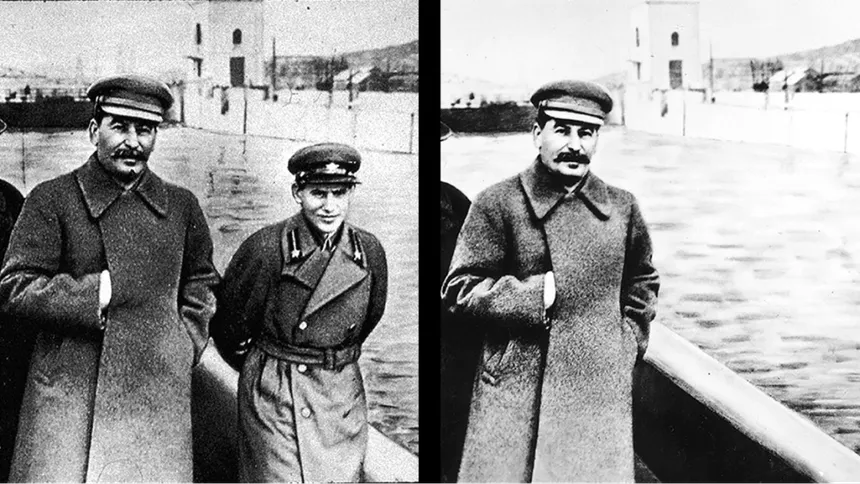
It will ultimately lead to a kind of tyranny that would make Stalin blush, and if there is nothing else I can do with my life it will be to warn the world — and most especially the American people, because they are likely to be the prime targets, right alongside the inner-party:
But let me also end with some suggestions to stave off the doom and gloom: there are open architecture chips based on the RISC-V standard now coming to market that should diversify and reinvigorate the industry from the bottom up, so that Richard Stallman’s dream of having open hardware and software systems for basic needs is within reach for the first time in a generation.
The market for hardware firewall / routers as a standard home appliance is likely to see growth, and experiments with software-defined radio mesh networks could soon make wireless communications secure again. There is hope!
The company’s co-founder, Peter Thiel, also funded a program at Professor Cowen’s Mercatus Center called “Emergent Ventures.”
Munn, Luke. “Seeing With Software: Palantir and the regulation of life.” Studies in Control Societies, 2017 (The software is able to correlate a person’s “home address, home telephone number, physical/mental information, social security number, and a photograph ... which enables the visualization of phone calls, emails, money, or any other material flows.”).
Paretti, Jacques. “Palantir: the ‘special ops’ tech giant that wields as much real-world power as Google.” The Guardian, Jul. 30, 2017.
See https://libreboot.org/faq.html#intelme (“The Intel Management Engine with its proprietary firmware has complete access to and control over the PC: it can power on or shut down the PC, read all open files, examine all running applications, track all keys pressed and mouse movements, and even capture or display images on the screen. … it has a network interface that is demonstrably insecure, which can allow an attacker on the network to inject rootkits that completely compromise the PC and can report to the attacker all activities performed on the PC. It is a threat to freedom, security, and privacy that can’t be ignored.”).
“A (Pretty) Complete History of Palantir.” Maus Strategic Consulting, April 27, 2014.
“POLICE REPORTEDLY TRIED TO TAKE JOURNALIST TO PSYCHIATRIC CLINIC.” The Jamestown Foundation, Jan. 24, 2000 (“Two Western newspapers reported on January 21 that Russian police last week raided the Moscow apartment of journalist Aleksandr Khinshtein in an attempt to take him to a psychiatric clinic … A spokeswoman for the Russian Union of Journalists said that Khinshtein was being persecuted for his journalistic activities.”).
Tseng, Sean. “Young Blogger Says CCP Tortured Her In Psychiatric Hospital To Silence Her.” Epoch Times, Jan. 18, 2025.
Streeck, Wolfgang. “Anti-Constitutional.” London Review of Books, Vol. 46, No. 16, August 15, 2024.